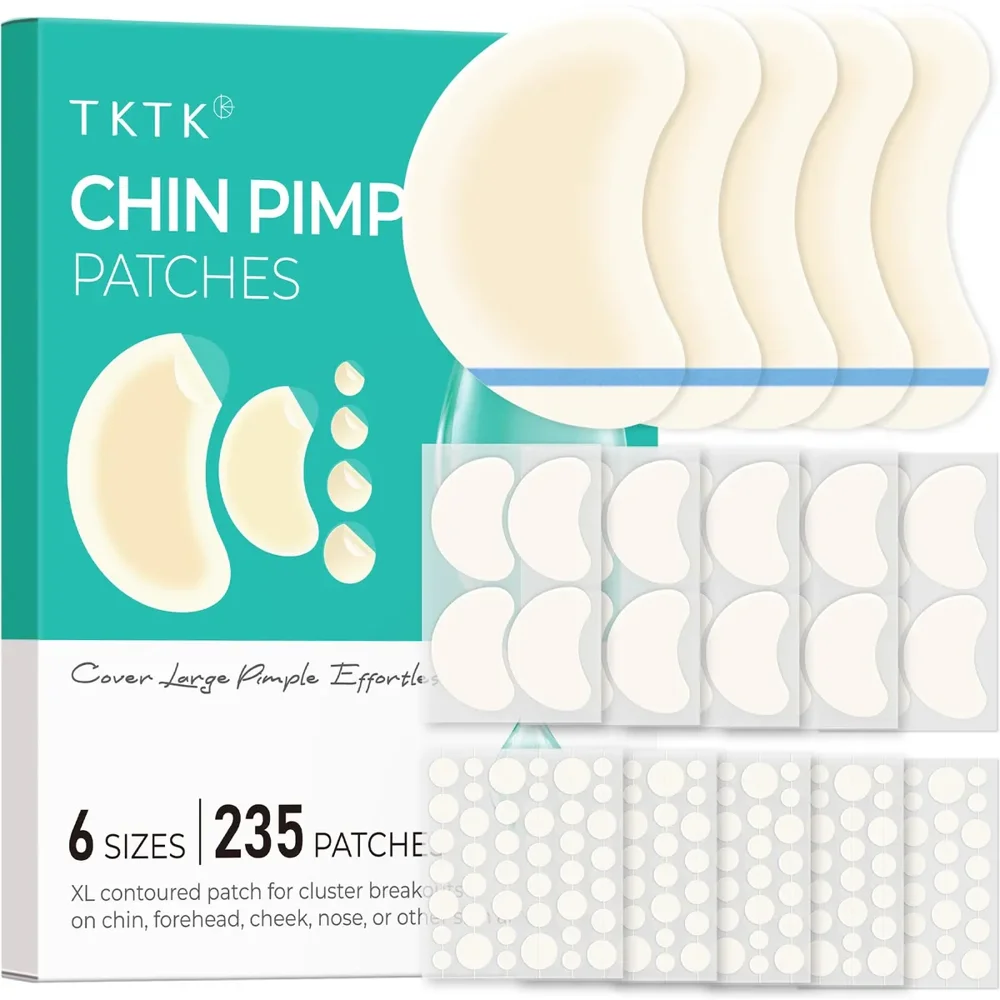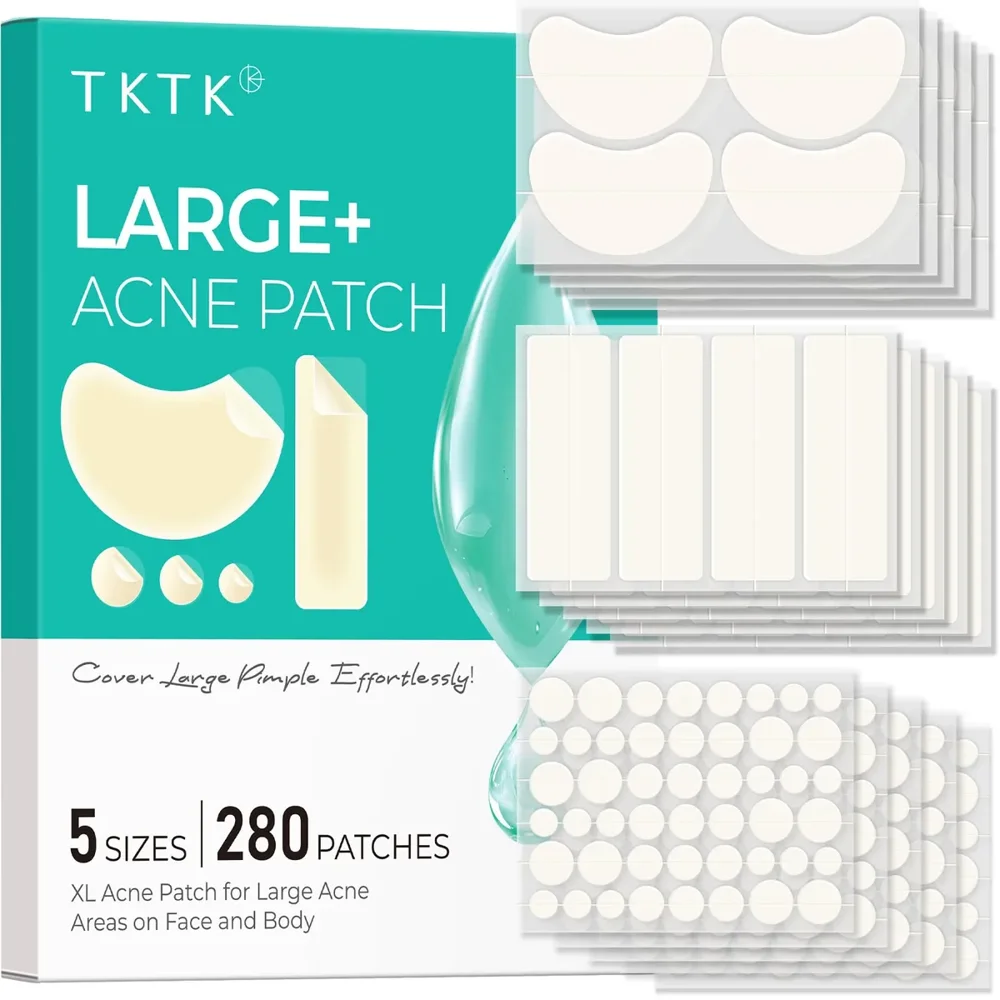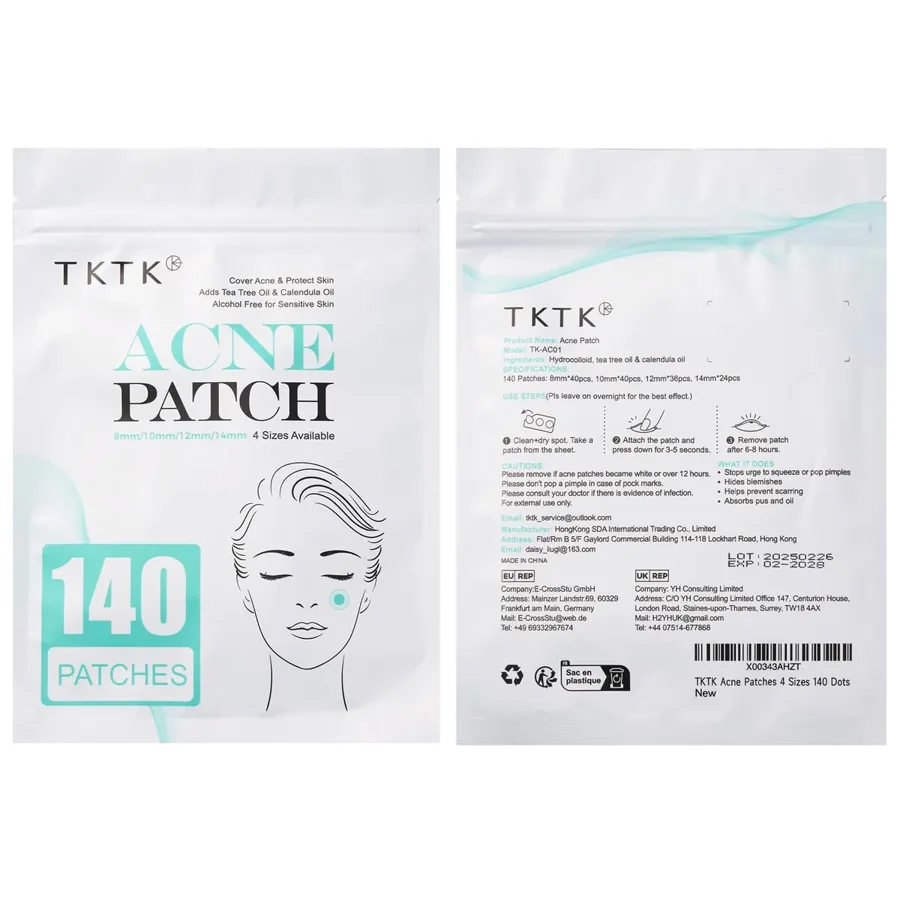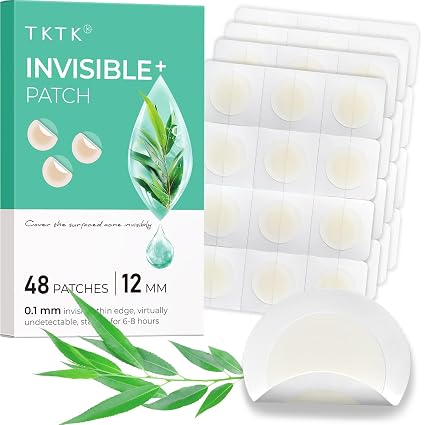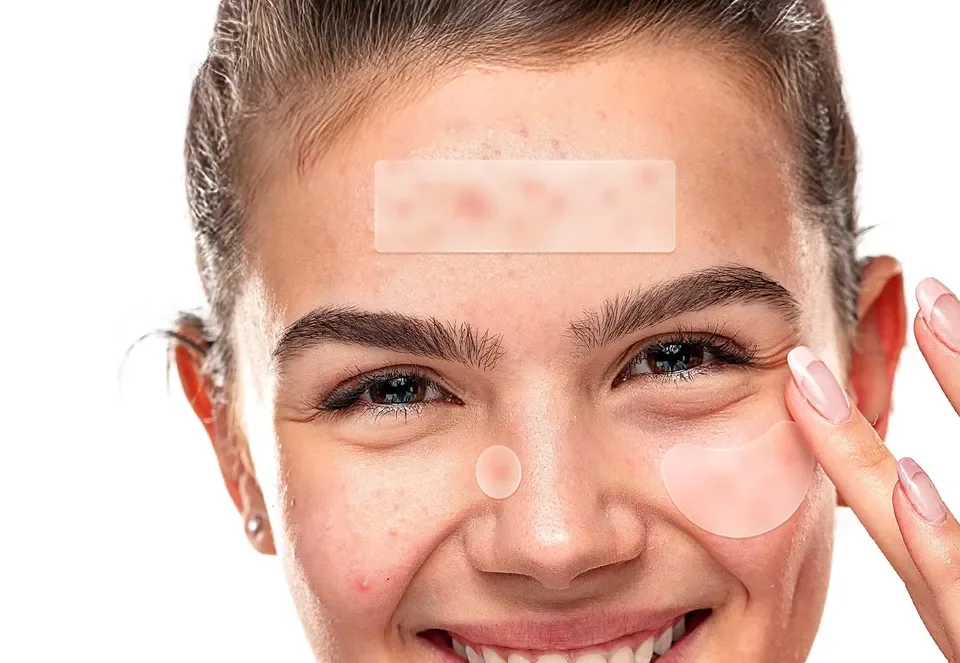
If you want to cover one spot and keep your fingers off it, start with a small, flat patch. TKTK's 16 mm Microdart is the more specialized purchase. It puts a 9 mm circle of dissolving points over a single blemish, surrounded by a smooth border. It makes sense to try the smaller 18-piece box if you specifically want that design and can wear it for the recommended six hours or overnight. We would skip it for someone who wants to cover several spots along the jaw or who expects a painful bump to disappear by morning.
TKTK sells enough shapes to fill a bathroom drawer. The worthwhile differences are visible once the packaging is out of the picture. There are dots with different ingredient lists, sheets that span a broad area, pieces shaped around a nose or chin, and a roll you cut yourself. We reviewed ten of these formats, taking a closer look at the Microdart because it offers the biggest change in construction. Three people who bought it disagreed about the result. Their accounts are more illuminating than the word “microdart” on the carton. TKTK Microdart product page
The patch you can feel beneath a fingertip
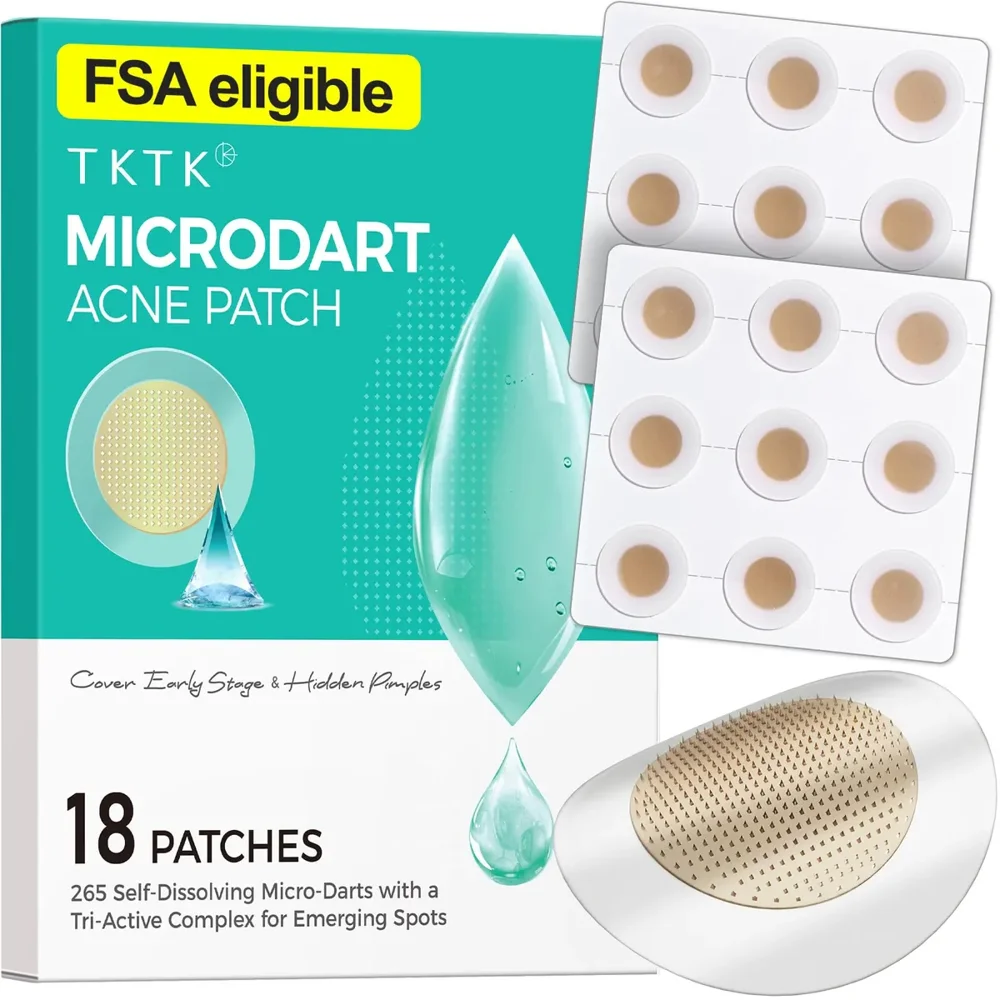
A regular spot sticker has two obvious surfaces. One faces the room, while the adhesive side sits against the skin. The TKTK Microdart adds 265 tiny dissolving points at the center of that second surface. The seller lists hydrocolloid, salicylic acid, niacinamide and sodium hyaluronate. Its gallery shows the package, blister sheets and a detail of the patch. The useful question to ask of that picture is how much of the circle actually carries points. They cover a smaller area than the disc as a whole.
It helps to picture the two circles at actual scale. Draw a circle sixteen millimeters across on paper and center another nine-millimeter circle inside it. There's about three and a half millimeters of border on either side along that line. That's the space left to make contact around the textured middle. If you want to cover several separated spots in a line, the darted center can reach only one small part of that line. A longer strip will cover more ground in a single piece. A close-up on a phone screen makes it surprisingly easy to miss that.
TKTK lists eighteen- and thirty-six-piece versions. The larger count changes how many individual patches you get. It does not double the area of each disc, give the points a different formulation or make the recommendation more certain. The first box is an opportunity to find out whether you like the sensation, whether the edge stays in place where you wear it, and whether the patch serves your purpose. All three questions concern your own experience, and all three can have different answers. TKTK Microdart dimensions and packs

Ten TKTK formats, sorted by the job they do
| Format | Detail that distinguishes it | When to look closer |
|---|---|---|
| Microdart | 16 mm disc, 9 mm darted center | One small, localized area and an overnight wear window |
| Original Dots | Four diameters, tea tree and calendula oils listed | Ordinary spot coverage with a choice of dot sizes |
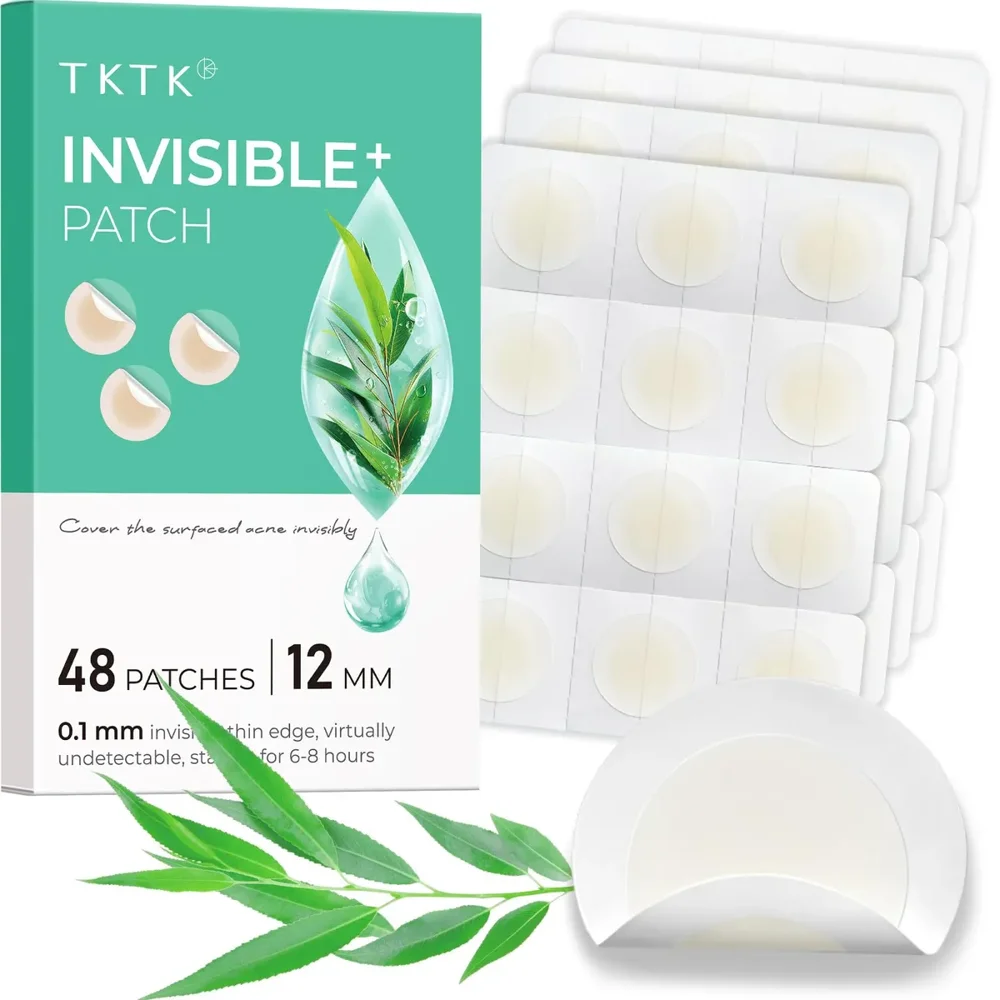
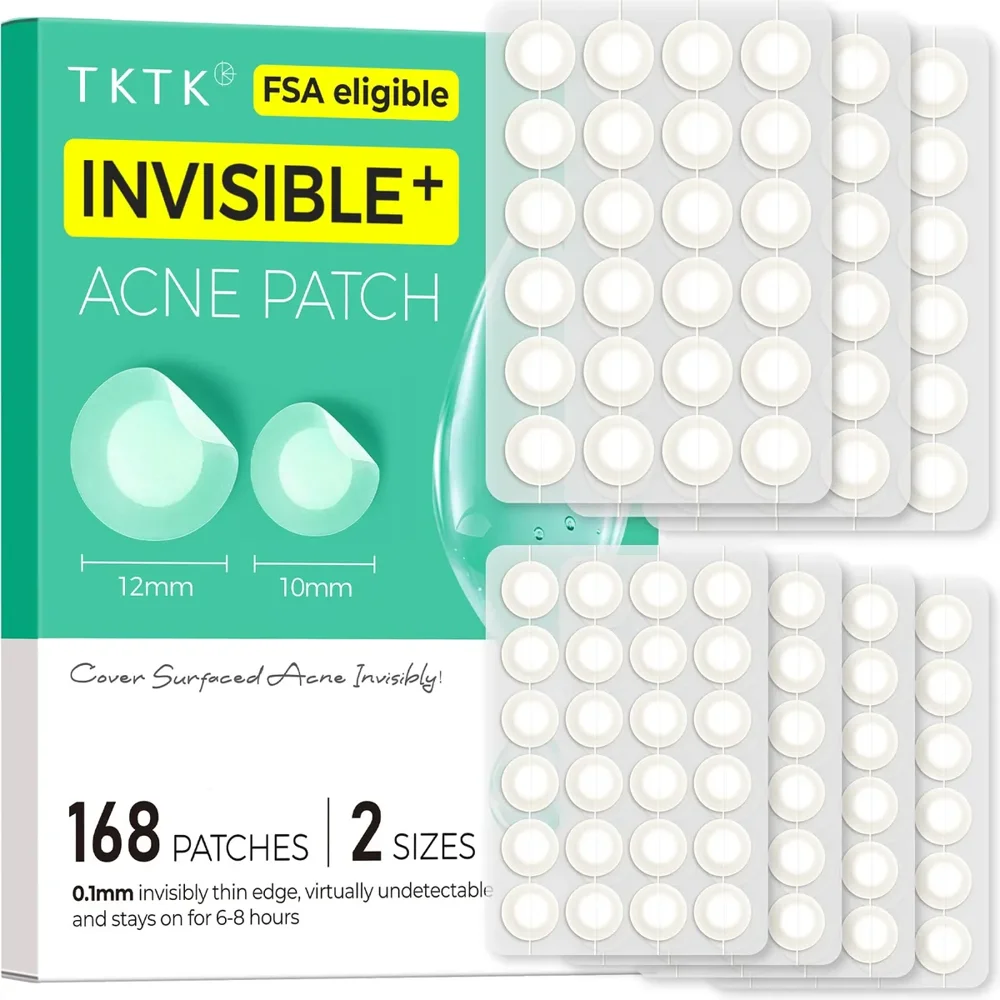
| Invisible+ | Salicylic acid listed, 12 or 15 mm dots | A flat daytime option and an ingredient list you have checked |
| Ultra-Thin Invisible | Thin flat cover | Your priority is a low-profile edge |
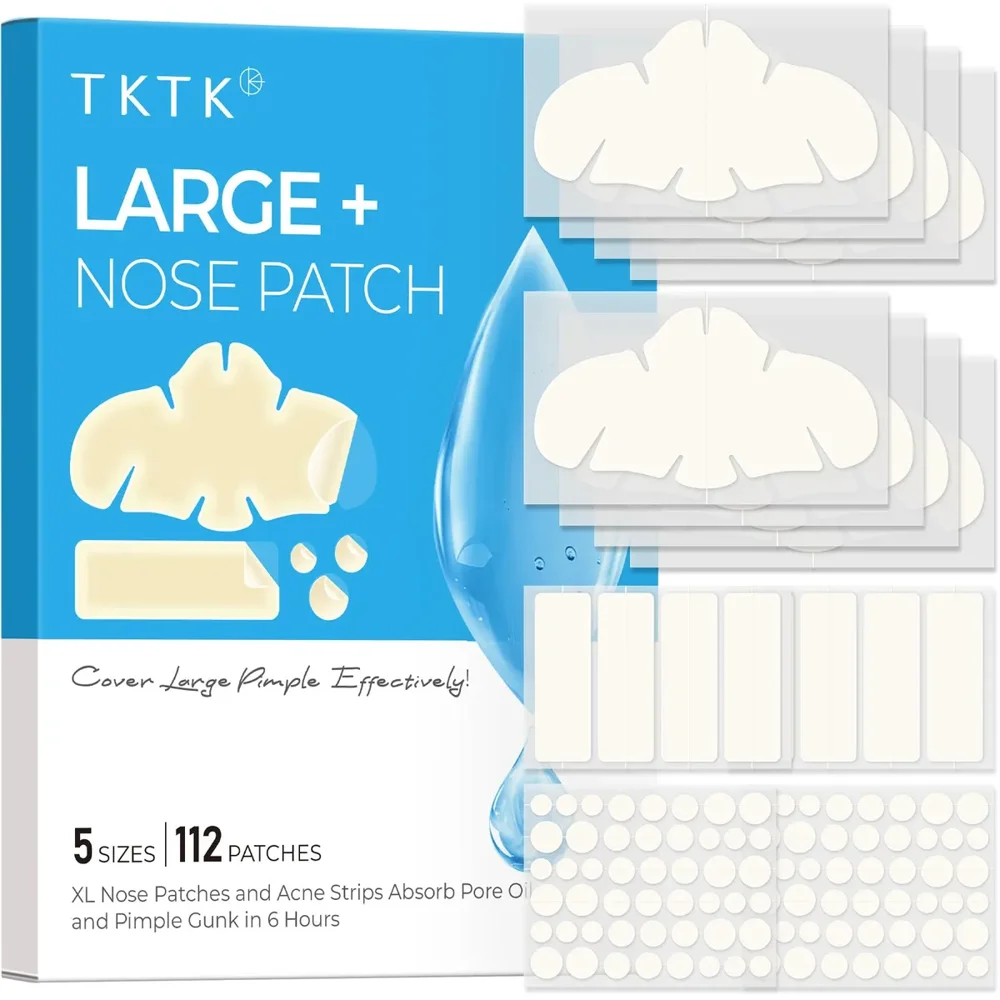
| XL Nose | Contoured piece, 91 × 48 mm | You want coverage across the nose |
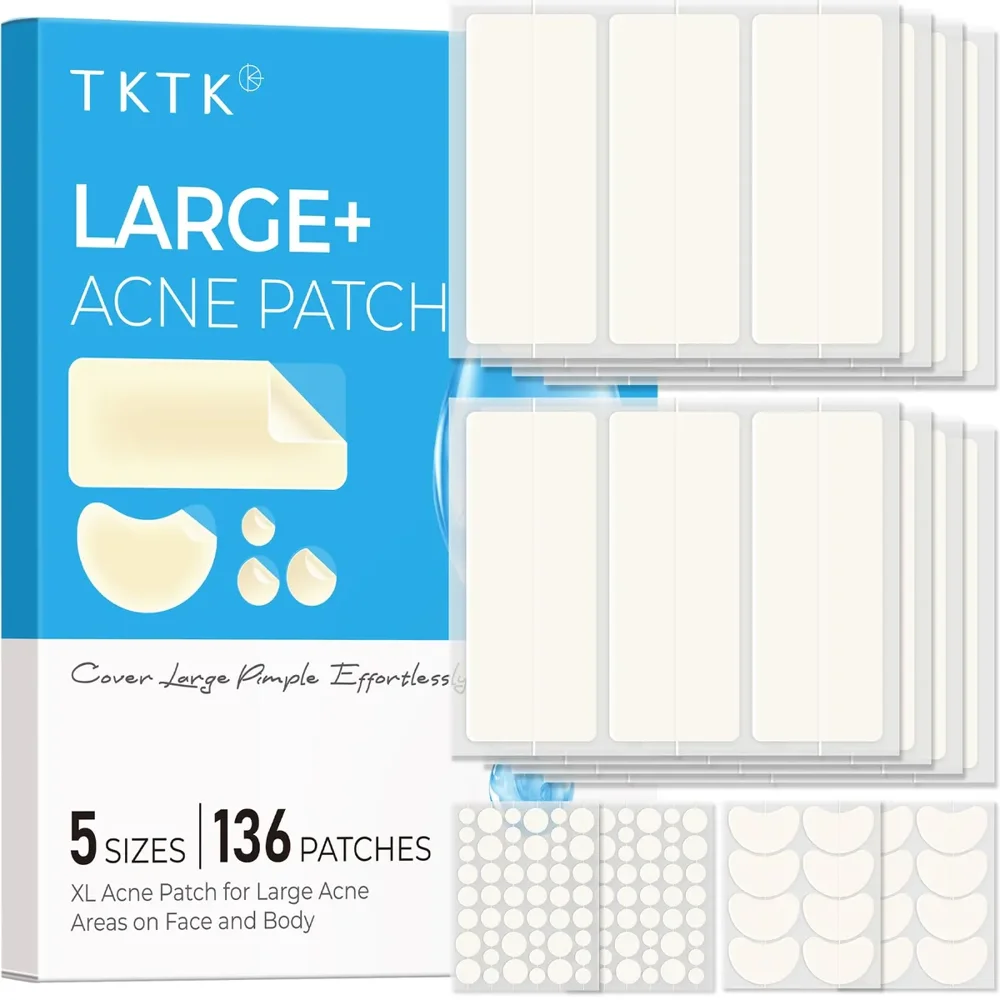
| Chin Patches | Broad shape drafted for the chin | A rectangular strip wrinkles under the lower lip |
| Moon Contoured | Curved pieces in a mixed-size set | You want to follow a curve with less trimming |
| 45 mm Squares | 45 × 45 mm square | A relatively flat, broad area |
| Large+ Strips | 68 × 27 mm rectangle | A long, narrower area |
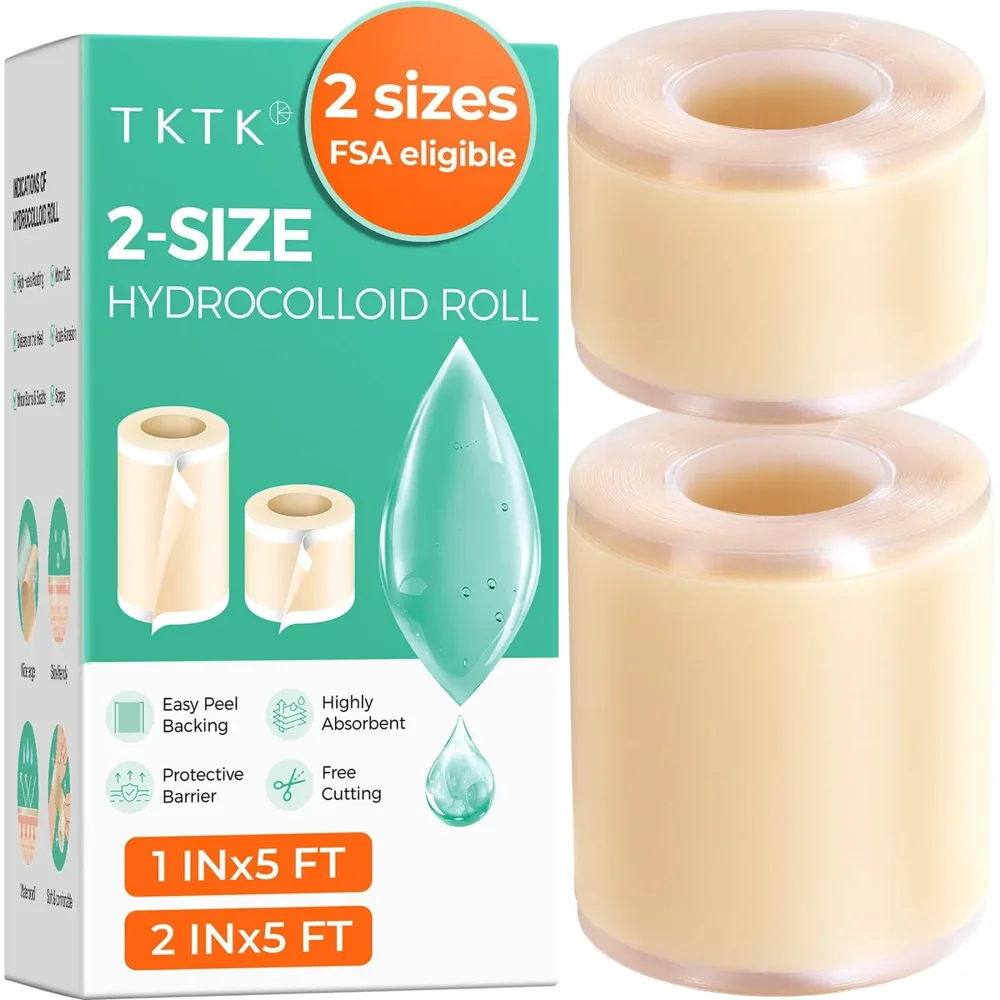
| Hydrocolloid Roll | Two widths, cut to fit | You want to choose each piece's length |
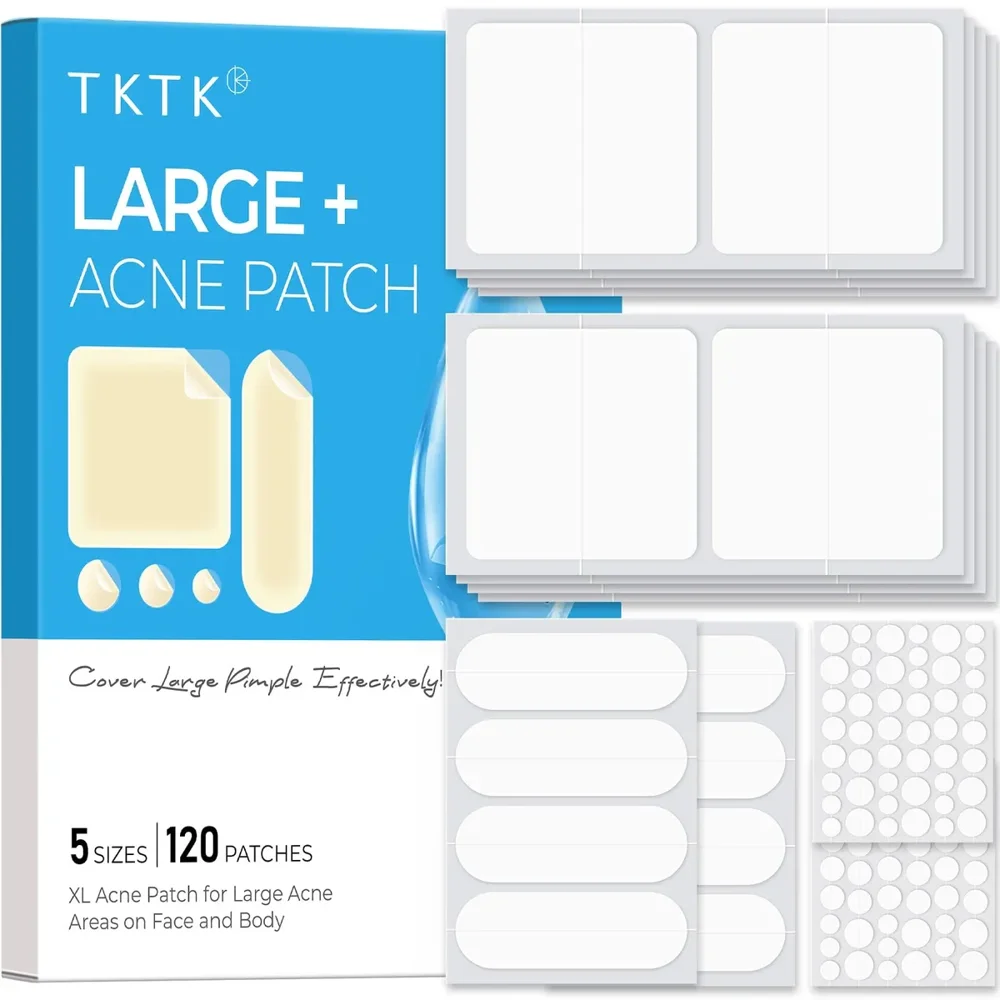
The plainest shopping decision is often about the border. An ordinary dot on a flat cheek needs a small ring of contact around one spot. A dot that straddles a crease beside the nose presents a different challenge. A larger patch can develop a fold in exactly the place you wanted it to lie smooth. TKTK's nose, chin and moon options spend more of the material following the shape of the face. Pick the shape by where it needs to lie, without assuming a larger number on the pack makes a better seal. TKTK size chart
The 45 mm square and 68 × 27 mm strip are a good example of why two packages marked “large” may feel quite different. The square is broader from side to side. The rectangular strip extends farther in one direction and leaves a narrower band across the other. Lay both outlines out on paper and the difference is immediate. If a line of spots would leave half a square sitting on clear skin, the strip may be the better purchase. If the area is roughly square, look at whether the longest strip would leave the top and bottom uncovered. 45 mm squares · 68 × 27 mm strips
The roll solves the length problem by letting you cut your own piece. That gives you more say over the shape but adds a small job every time you need one. A pre-cut dot or chin piece makes more sense to put in a bag if you want to open a sheet and apply it immediately. The roll makes more sense to leave at home if you often find yourself needing a length between two ready-made sizes. Keep its original directions and storage information with it after you open the box. TKTK cut-to-fit roll · Contoured chin patches
Flat dots have different ingredient lists, too
A circle on the front of a packet is a poor guide to its ingredients. TKTK's Original Dots name tea tree and calendula oils. The Invisible+ page specifically names salicylic acid. The Microdart also lists salicylic acid and adds niacinamide and sodium hyaluronate to its description. If you already know that a particular ingredient doesn't agree with your skin, the full current ingredient panel is the place to start. There's little point choosing a dot for its nearly invisible edge if you already have a reason to avoid its formula. Original Dots · Invisible+
For someone who wears a patch during video calls or at work, the low-profile Ultra-Thin is a reasonable format to investigate first. Look at the actual edge and surface in the gallery. A shiny surface may catch a window reflection, and a lifted edge can cast a shadow. Both will look different under bathroom lighting and in daylight. The name “invisible” describes the intended appearance. It can't predict how a particular patch will look against your skin, with your usual moisturizer, in a moving conversation. Ultra-Thin Invisible
What changes when you compare TKTK with Hero and ZitSticka?
A fair comparison for the Microdart is another patch designed for an emerging spot with dissolving points. A tray of several hundred flat dots answers a different question. Hero Cosmetics sells Mighty Patch for Early-Stage Blemishes in a box of eight. It specifies 395 points, a hydrocolloid layer, salicylic acid and cica. ZitSticka's standard KILLA Kit includes matching prep swabs and patches, in counts of four, eight or twenty. Its standard patch has 24 dissolving darts. The company also sells an Extra Strength product with different directions and claims, so check the name before comparing. Hero product page · ZitSticka KILLA Kit
| Published specification | TKTK Microdart | Hero Mighty Patch for Early-Stage Blemishes | ZitSticka KILLA Kit |
|---|---|---|---|
| Count per pack | 18 or 36 | 8 | 4, 8 or 20, with the same number of prep swabs |
| Points per patch | 265 | 395 | 24 |
| Direction for initial press | 5 seconds | Lightly, 20 seconds | Firmly, 30 seconds |
| Listed wear window | At least 6 hours or overnight | 6–8 hours | At least 6 hours or overnight |
| Distinctive feature | 9 mm central area on a 16 mm disc | Hydrocolloid layer and cica listed | Separately packed CLEANA preparation step |
The numbers are precise enough to sound like a league table. They tell us how many projections the company says it built into the patch. They don't tell us how much salicylic acid reaches the same point, whether all three centers cover the same area, how an individual reacts to an adhesive, or which brand has a better clinical outcome. We found no trial comparing these three exact products side by side. Someone who values a short initial press might choose TKTK. Someone who wants preparation and application packaged together has a concrete reason to choose ZitSticka.
The directions differ enough to matter to anyone switching brands. Pressing one product lightly for twenty seconds doesn't turn that into the proper instruction for every disc with dissolving points. Read the box you have in hand and follow its directions for wear and removal. Hero also gives an interval before another application if needed. A person accustomed to Hero could easily carry that habit over to TKTK, or do the opposite, without noticing the changed wording. Keeping the original packaging is more useful here than memorizing a single routine from a social video.
Three buyers, three different mornings
The TKTK page reproduces three dated accounts labeled verified purchases. Brenda C. H., writing July 4, 2026, described using the patch on stubborn bumps that hadn't developed a visible head. In her experience a change appeared after one or two nights. That's the outcome most likely to attract someone to this design, but the account doesn't tell us how a comparable bump would have developed during two nights without it. The useful detail is the time frame she reports, which is more modest than an expectation of instant clearance. Amazon buyer review Buyer accounts on the TKTK listing
Jayme, on May 2, found the points noticeable on application. The patch stayed in place and looked unobtrusive enough to forget about, yet the visible change after two nights was smaller than she'd hoped. Her short description of the wear experience is unusually clear: “It does stay exceptionally well.” A good adhesive experience and a disappointing result can coexist. If the reason you're buying is to stop touching one spot during the evening, part of that account is encouraging. If the entire purchase depends on a change by the following morning, her experience argues for caution. Amazon buyer review
DNA, writing June 22, had almost the reverse experience with the border. The edges needed more attention to adhere. They reported little improvement and wouldn't buy the product again. Put alongside Jayme's comment, this is a useful disagreement. One person's easy seal doesn't make the other person's lifting edge implausible. We don't know whether the two people wore the patch at the same location, whether they used the same skin products beforehand or whether they slept on it. The reviews give a reason to try a smaller packet before committing to a larger one. Amazon buyer review
The page lists 4.2 out of five from 302 ratings for one pack choice and a separate five out of five from 22 for the other. Those scores belong to different counts and sample sizes. Five stars from 22 people does not show that doubling the box size improves the patch. The page identifies purchases in the quoted accounts, but it doesn't publish the total number of boxes sold. Amazon displayed 200 or more bought in the past month for TKTK's separate 12 mm daytime patch on November 14, 2026. That approximate threshold belongs to the daytime listing and says nothing about the number of microdart boxes sold.
What the clinical evidence can actually support
The American Academy of Dermatology describes a hydrocolloid patch as one option for protecting the skin over a pimple. It also advises leaving deep, painful bumps alone rather than squeezing them. That advice is relevant if the main reason you want a patch is to interrupt the habit of feeling the same spot throughout the day. Persistent, deep or scarring acne is a different problem. The academy advises seeing a dermatologist for large, painful lesions deep in the skin or when breakouts leave scars. AAD guidance for deep pimples · AAD adult acne guidance
A small published trial gives the distinction between evidence for a material and evidence for this particular box some context. Chao and colleagues compared a 3M hydrocolloid acne dressing with ordinary skin tape in twenty people with mild to moderate acne. They followed participants for up to one week. The dressing group showed greater improvement on several measures, including overall acne severity and inflammation, over part of that follow-up. The team studied a specific dressing against tape. TKTK's 265-point disc and its added ingredients were outside that experiment. Chao and colleagues, randomized pilot study
Reading the two sources together yields a sensible, limited expectation. A physical covering can be useful, and some research supports a particular hydrocolloid dressing in mild to moderate acne. We still don't have direct evidence here that adding a dissolving center to this patch will shorten the life of an individual deep bump by a predictable number of hours. The seller's six-hour wear instruction is an instruction about use. Treating it as a performance guarantee would turn a practical detail into a promise the evidence doesn't support.
A buyer can get a more useful answer from one small box by deciding what she wants to observe before opening it. Did the edge stay down for the wear window specified on the pack? Did she leave the area alone while it was covered? Could she remove the disc comfortably according to the directions? Did the spot look different in comparable light the next day? The first three questions can help judge whether the product fits a routine even when the last one is ambiguous. One good or bad night still cannot establish a general medical effect.
What to look for in photographs and video
The most instructive image of the Microdart shows the front of the pack alongside the blister sheets and a magnified view. It explains why a packet of eighteen takes a different form from a flat sheet of small dots. Compare it with the nose strip package and the 45 mm square. The scale markings and cut lines show where the shape changes. A glossy close-up of skin with no way to tell which patch was used adds much less to a decision. These are photographs in the product catalogues. We couldn't verify customer ownership of those images. Microdart gallery · XL Nose gallery · Square patch gallery
For a filmed demonstration of a competing design, Hero's page includes its own video for Mighty Patch for Early-Stage Blemishes. Watch how the manufacturer distinguishes the raised center from the backing, then read the accompanying directions for its particular product. This is a Hero demonstration. A TKTK-specific clip would be the appropriate reference for its five-second press and its own blister arrangement. We couldn't verify a public demonstration of the exact Microdart from a purchaser, so the three written TKTK accounts carry more weight here than unrelated patch videos. Hero video and illustrated directions
A mixed pack can contain fewer of the patch you want than you think
Suppose you want a strip for the bridge of the nose and find a package marked 112 pieces. On TKTK's XL Nose selection the box contains a mixture of shapes. The large number on the front describes the contents together. Before dividing a price by 112 and comparing it with a box of nose-only strips, look for the breakdown by shape on the back. If you would use every dot as well, a mixed box has real value. If most of the contents would stay in the drawer, the most useful number is the count of nose pieces.
The same arithmetic applies to the four-shape variety packs, which pair useful small dots with larger contoured pieces. Lay out the two or three shapes you actually buy repeatedly. A box with a close match for those habits may save you from keeping several pouches open. A larger box heavy on shapes you rarely reach for could be a worse buy, even if its average price per patch looks attractive. With the Microdart, the comparison is easier because the 18- and 36-piece boxes are choices within one format. With assortments, check what each piece actually does. TKTK nose patch sizes · TKTK four-shape assortment
Think about where you'll keep the package as well. A flat sheet that fits in your usual toiletry bag is a different proposition from a blister tray that protects a raised surface. If you often tear off just one patch for travel, check that its backing and instructions can come with it. You'll want to know which kind you packed when several brands look like translucent discs in the bottom of a pouch. A photo of the box on your own phone can be more useful on the road than relying on the shape alone.
Our verdict
We recommend the 18-count TKTK Microdart as a small trial for someone who wants its particular single-spot format, has checked the ingredients and expects to wear it for the stated window. We don't recommend it as a promise of overnight clearance or as the main answer to recurrent deep or painful acne. For a simple physical cover, the Original Dots offer more choice of diameter. For a long area, choose the strip. For an awkward curve, examine the cut of the chin or moon patch before reaching for a bigger rectangle. The best reason to buy one of these packages is that its actual shape and ingredients fit the job you want it to do.